

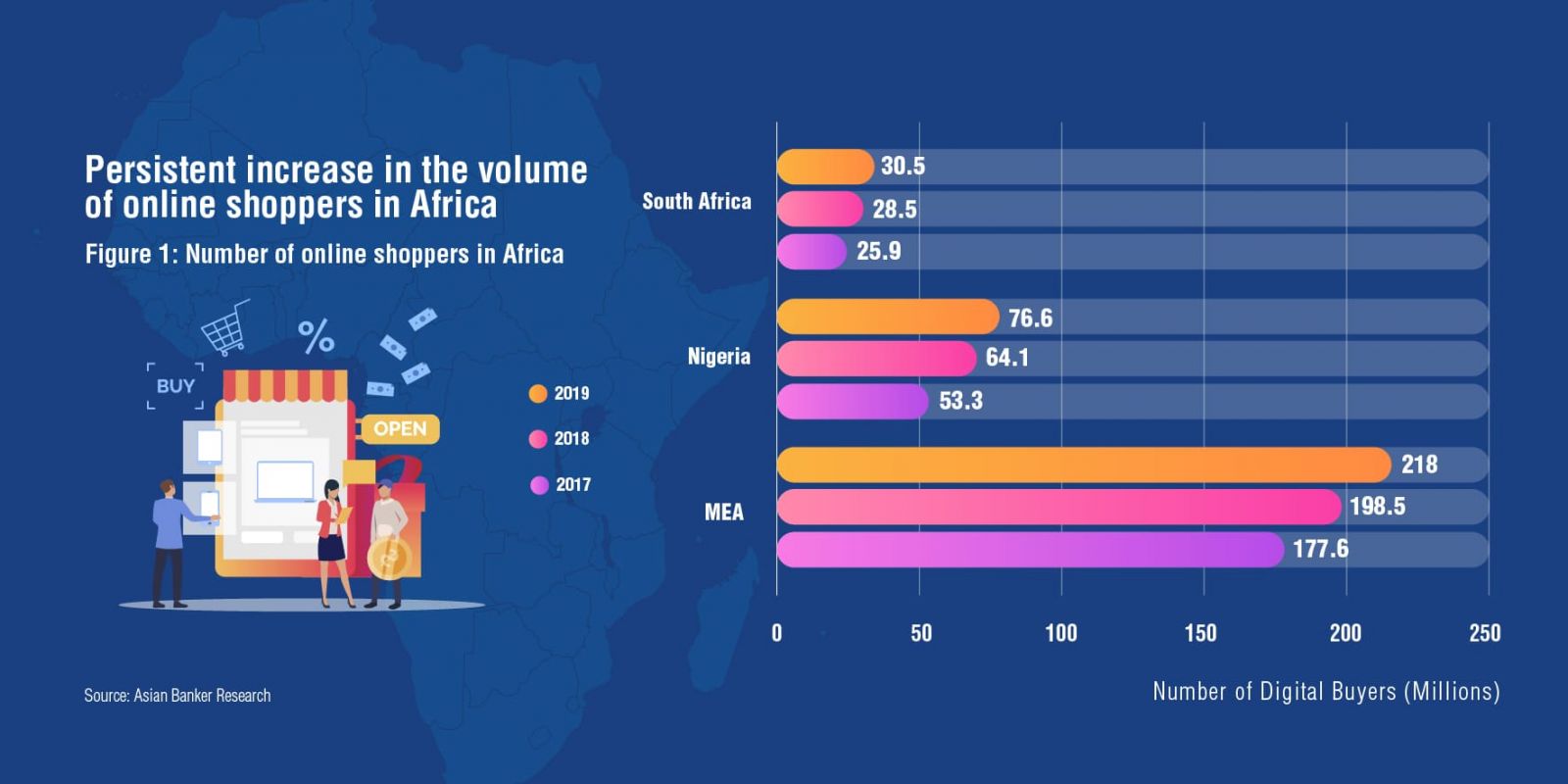
Africa’s e-commerce landscape is growing, with more players entering the industry. With increased e-payment innovations and technical security, Sub-Saharan Africa will continue to see growth in is number of online shoppers.


With the reprieve on know your customer regulations on certain segments, banks and new challengers are rapidly integrating eKYC into their processes to offer customers an improved onboarding journey
Industry experts analyse how financial crime dynamics and cybercrimes are becoming more sophisticated with digital disruption and share their views on what banks could do to address the alarming issue
Pressure on margins from increased competition and compliance requirements is forcing the industry to recalibrate its trade finance offerings. While institutions know that trade digitalisation is important for the future of the business, success relies heavily on deeper coordination and collaboration between the myriad participants in the trade finance ecosystem and technology enablers
Given that remittances are so lucrative in so many markets in Asia, and that new competitors are offering faster and cheaper services, banks will need to develop new models if they want to keep their customers.
Driven by competition and rapid disruption, banks increasingly spend on technology enabled models targeted to improve customer experience and service capability. What are the recent developments and top priorities of banks in 2018?
Losses from cybercrime has increased sharply as ransomware incidents soar, ‘cybercrime as a service’ provides greater access and new threats emerge, forcing banks to implement multilayered and stronger technology enabled IT risk and security frameworks.
Cyber-threats have become increasingly complex, inflicting high monetary and reputational damages to institutions that, despite various measures, are forced to plan “catch up” to the advanced technology of criminals. As regulators expand advisories, the institutions now need stronger multi-layered cyber-resilient initiatives.
Spurts in prices of cryptocurrencies and initial coin offerings over the last two years, with start-ups raising millions in minutes, have raised excitement and regulatory attention amid fear of “bubble” and potential losses.
Investments and interest in distributed ledger technology have been rising rapidly as new use cases emerge to harness its potential. The technology is nonetheless still at an early stage with many hurdles to cross, possibly five to seven years away from mainstream adoption.
Robotics, enabled by artificial intelligence and machine learning, is proving to be a game changer that can bring unique operational efficiencies to the financial services industry.
New proofs of concepts have emerged in blockchain as the industry tackles various impediments to its successful adoption. The technology initiatives would need to be complemented with stronger collaborative efforts and interoperability for future growth.